Not Just Canvas and Colors: How Online Painting Helped Me Reset My Sleep and Myself
You know that restless feeling—lying in bed, mind racing, unable to shut off? I was stuck in that loop until I stumbled on an unexpected fix: painting online. It wasn’t about talent, but timing. Dipping into a digital canvas each evening became my ritual, pulling me away from screens and stress, guiding me into calmer nights. This is how creativity, in the gentlest way, rewired my rhythm. No fancy tools, no art degree—just me, a tablet, and soft evening light. What began as curiosity turned into something deeper: a nightly act of kindness toward myself. And slowly, my sleep, my mood, even my days, began to shift.
The Nighttime Struggle: When Sleep Feels Out of Reach
There was a time when bedtime wasn’t rest—it was a battlefield. I’d crawl under the covers, physically exhausted, yet mentally wide awake. My brain wouldn’t shut down. I’d replay the day’s conversations, worry about tomorrow’s to-do list, or just stare at the ceiling, counting minutes like sheep. I wasn’t alone—so many of us know this ache, this gap between being tired and actually sleeping. I tried everything: herbal teas, white noise machines, journaling, even those sleep meditation apps with the calm voices guiding me through imaginary meadows. Some helped a little, but nothing stuck. The real issue wasn’t just insomnia—it was the lack of a true transition from day to night. My brain needed a signal, a soft handoff from activity to stillness. I was looking for peace, but I kept reaching for solutions that felt clinical, disconnected from real life. What I didn’t expect was that the answer wouldn’t come from a sleep expert or a doctor’s recommendation, but from something that felt playful, almost childlike: drawing on a screen.
Think about it—our days are full of demands. We juggle work, family, meals, errands, and the endless ping of notifications. By night, we’re not just tired—we’re mentally cluttered. And yet, we often expect ourselves to flip a switch and fall asleep. That’s not how the brain works. It needs time to wind down, to release the tension of the day. Without a real ritual, we’re left in this in-between space—awake but wishing we weren’t. I realized I wasn’t just fighting sleep; I was fighting the buildup of the entire day. What I needed wasn’t another tracking app or supplement, but a way to gently disengage. Something that felt less like a chore and more like a gift to myself. That’s when I discovered that creativity, not control, was the key.
Discovering a Digital Brush Instead of a Sleep Tracker
It happened by accident. One night, instead of opening social media or watching another episode, I opened a painting app I’d downloaded months ago and forgotten about. I wasn’t trying to be artistic—I just wanted to do something different. I started with a blank canvas, chose a soft blue, and made a few random strokes. Then a yellow swirl. Then a simple tree shape. No plan, no pressure. And something shifted. The act of focusing on color, on movement, on the quiet decisions of what to paint next, pulled me out of my head. It wasn’t meditation, but it felt meditative. I wasn’t trying to clear my mind—I was filling it with something gentle, something creative. For the first time in weeks, I wasn’t thinking about what I should’ve said at the meeting or what I still needed to do. I was just… present.
That night, I slept deeply. Not because I was more tired, but because my mind was quieter. I didn’t realize it then, but I had stumbled onto a powerful truth: creative flow can be a bridge to rest. Unlike sleep apps that ask you to focus on breathing or visualize darkness, painting gave me something active to do—yet it calmed me. It engaged just enough of my attention to keep anxiety at bay, but not so much that it overstimulated me. It was like a mental massage. The next night, I did it again. And the night after that. What started as a curiosity became a habit. I wasn’t painting masterpieces—some nights, it was just colorful scribbles—but the act itself was healing. I wasn’t tracking my sleep stages; I was creating a space where sleep could find me naturally.
Why Painting Works Where Other Tools Fail
We’ve all tried the usual fixes: melatonin, blackout curtains, no screens after 8 PM. And while those help some people, they didn’t solve the root problem for me—my overactive mind. The issue wasn’t that I wasn’t tired; it was that my brain wouldn’t let go. Painting worked because it didn’t fight my thoughts—it gave them a new channel. Instead of trying to suppress my racing mind, I gave it a gentle task: choose a color, make a stroke, blend two shades. These small decisions kept my focus anchored in the moment, without the pressure of performance. It’s like how knitting or coloring books calm people—the rhythm, the repetition, the soft engagement. But digital painting added something extra: freedom. No need to worry about smudging, running out of space, or making a mistake. I could undo, erase, start over. It felt safe. It felt forgiving.
Science backs this up. Studies have shown that engaging in creative activities lowers cortisol, the stress hormone. When we create, even in simple ways, our brains release dopamine, the feel-good chemical. We enter a state of ‘flow’—a term psychologists use to describe complete absorption in an activity. In flow, time slows, self-criticism fades, and we’re fully immersed. That’s the opposite of anxiety. And while meditation is wonderful, it doesn’t work for everyone. Some of us struggle to sit still and ‘clear the mind.’ Painting offers a backdoor to that same calm—it’s mindfulness in motion. You’re not forcing stillness; you’re moving into it through creation. For me, it wasn’t about the final image. It was about the 20 minutes where I wasn’t a mom, a worker, a planner—I was just someone making something for no reason at all. And that freedom was deeply restorative.
Building a Personal Evening Ritual Around Creativity
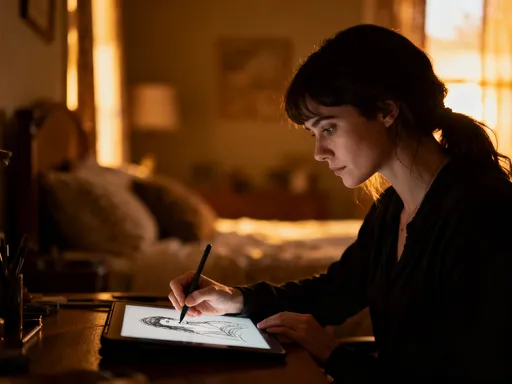
Once I noticed the difference, I wanted to make it consistent. So I created a simple ritual: every night, 30 minutes before bed, I paint. No exceptions, no ‘I’ll do it tomorrow.’ I treat it like brushing my teeth—non-negotiable. I set the mood: dim the lights, put on soft instrumental music, maybe light a candle. I use a tablet with a stylus, but a laptop or even a phone works too. The key is making it feel special, not rushed. I don’t aim to finish anything. Some nights, I paint a landscape. Others, I just play with textures and gradients. The goal isn’t beauty—it’s presence. Over time, my body began to recognize the pattern. The moment I picked up the stylus, my nervous system started to relax. It became a signal: the day is done. It’s time to slow down.
Rituals matter because they train our brains. We’re creatures of habit, and our bodies thrive on predictability. When we do the same calming thing every night, we build a neural pathway that says, ‘This leads to sleep.’ It’s like training a dog with treats—but the treat is rest. I’ve found this more effective than any alarm clock or sleep app. Technology often gets blamed for ruining our sleep, but what if we used it differently? What if, instead of scrolling through endless feeds, we used our devices to create, to express, to unwind? That shift—from passive consumption to active creation—changed everything for me. It wasn’t about adding more to my plate; it was about replacing something draining with something nourishing. And the more I painted, the more I looked forward to bedtime. Who says that can’t be a good thing?
How Online Platforms Make This Accessible to Everyone
One of the best parts? You don’t need any special skills or expensive supplies. I used to think painting was for artists, for people with talent. But digital tools have changed that. Platforms like Paintstorm Studio, ArtRage, or even free apps like Infinite Painter or Sketchbook are designed to be intuitive. You don’t need to know how to draw a perfect face or mix real paint. You just need a device and a few minutes. The brushes feel realistic, the colors blend naturally, and there’s no mess to clean up. You can experiment without fear. Want to try watercolors? Click a button. Prefer oils? Switch with a tap. Made a mistake? Undo it with a swipe. It’s forgiving, flexible, and fun.
My sister, a busy mom of two, started doing this too. She uses her old iPad during the kids’ bedtime routine. She told me, ‘I don’t even care what I’m making. I just like the way it feels.’ And her family noticed the change. ‘Mom seems calmer now,’ her daughter said. That’s the thing—this isn’t about becoming the next Van Gogh. It’s about giving yourself permission to play, to create just for the sake of it. These platforms lower the barrier so anyone can start. No art school, no supplies, no pressure. Just open and begin. And because it’s digital, you can save your work, revisit it, or delete it—no guilt. Some of my earliest ‘paintings’ were chaotic swirls of color. Now, I see them as proof of progress. They weren’t art—they were therapy.
Balancing Screen Time with Mindful Use
I know what you’re thinking: ‘But screens keep me awake!’ And you’re right—most screen use before bed is harmful. Scrolling through social media, checking emails, watching intense shows—these activate the brain. They’re full of blue light, fast movement, and emotional triggers. But not all screen time is the same. Using a device to create is different from using it to consume. When I paint, I’m in control. I set the pace. I choose the colors. I decide when to stop. It’s active, not passive. And I’ve made small adjustments to protect my sleep: I use night mode to warm the screen’s tone, lower the brightness, and limit sessions to 20–30 minutes. I don’t paint in bed—I sit at a small table, so my body knows this isn’t sleep time yet, but a step toward it.
The key is intention. When I pick up my tablet to paint, I say to myself, ‘This is for calm. This is for me.’ That mindset shifts everything. It’s not entertainment; it’s self-care. And research shows that mindful screen use—where we’re fully present and engaged—doesn’t disrupt sleep the way mindless scrolling does. In fact, it can support it. The screen isn’t the enemy; it’s how we use it. For years, I avoided screens at night completely. But that felt restrictive. Now, I’ve reclaimed my device as a tool for peace, not stress. It’s not about banning technology—it’s about redefining its role in our lives. What if your phone or tablet wasn’t a source of distraction, but a portal to calm? That’s the shift I’ve made. And it’s made all the difference.
The Ripple Effect: Better Sleep, Better Days
When sleep improves, everything improves. I started noticing changes beyond the night. I woke up feeling clearer, more patient, more like myself. I had more energy to engage with my family, to tackle chores without resentment, to enjoy small moments. My creativity didn’t stop at painting—it spilled into cooking, where I started trying new recipes just for fun. I planned weekend outings with more enthusiasm. Even my conversations felt richer, more present. I wasn’t just surviving the day—I was living it.
And the best part? This wasn’t a quick fix. It was a slow, steady shift. I didn’t wake up one morning cured. But over weeks, I felt lighter. My anxiety didn’t vanish, but it lost its grip. I had a new way to process the day, to release tension, to reconnect with myself. Painting became more than a bedtime ritual—it became a form of self-respect. It reminded me that I matter, that my peace matters, that taking time for myself isn’t selfish—it’s necessary. I started encouraging friends to try it. One said, ‘I don’t know how to draw.’ I said, ‘Neither do I. Just make marks. See how it feels.’ And she did. Now, she texts me her digital doodles. We laugh about how ‘bad’ they are. But we both sleep better.
Finding Calm in the Most Unexpected Place
Sometimes, the best solutions come from the most unlikely places. I didn’t find peace in a luxury spa or a high-tech sleep tracker. I found it in a simple act of creation, done quietly, consistently, just for me. Online painting didn’t fix everything—but it gave me a starting point. It taught me that rest isn’t something we earn; it’s something we build, moment by moment. It reminded me that I don’t need to be perfect, productive, or polished to deserve calm. All I need is a few minutes, a screen, and the courage to make a mark—any mark. Because in that small act, I’m choosing myself. I’m saying, ‘You’re worth this time. You’re worth this peace.’ And that belief, more than any technique, has changed my life. If you’re lying awake tonight, heart heavy with the weight of the day, maybe what you need isn’t another app, another pill, another fix. Maybe what you need is a brush. Not to create art—but to find yourself again.